by Ebenezer Veerasingam
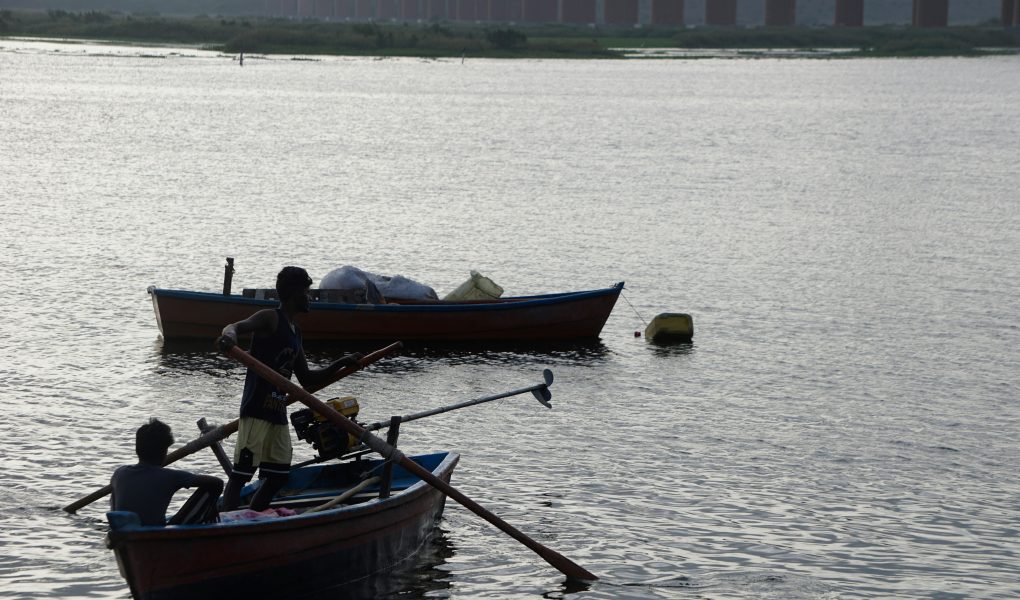
The boat glided sedately, whispering secrets across the still lagoon. The full moon, like a pendant made of a large pearl, adorned the newness of the night. The moonshine carpeted the water’s surface, making it glimmer in silver and gold. Flowing over the lagoon, the soft breeze tickled the vigilant ears that would otherwise attend to the slightest strangeness. The boatman’s rhythmic oars played semibreves of water splash in the moonlit darkness, and the infant heaving of the boat could have lulled human thoughts into a deep slumber.
“Let’s get under the bridge while it’s still calm,” Ithayarajan said with determination, pointing at the giant pillars standing in pairs and bearing the bridge’s weight across this deep lagoon.
“Ohm, Aiya,” replied the boatman in agreement, steadying himself to the tempo of his paddling beats.
The mangrove shrubs on the banks, exposing their naked roots over the water level, were stepping into the evening curfew mode. The prawn catchers had already hanged their lanterns on poles positioned in the edging waters, and the alternating lights on either side fenced the lagoon in the accumulating darkness. Above these silenced shrubs, balancing in agreement, were clusters of dichotomously branched palmyrah trees keeping within themselves the mysteries of colonial ecology. The giant iron bridge built in the British era was no longer known as the place to listen to nature’s lullaby.
As a city surrounded by the invading waters of the Indian Ocean, Batticaloa has been necklaced by the beauty and grandeur of its lagoon. Though the written histories of yesteryear bring life and death to its mysteries, the lagoon continues to live for the people, who, in turn, live to witness these mysteries, and be nursed by them. Centuries of belief brought fame and eminence to this land by the rarity of the fish living in the lagoon. One of the finned creatures, with its unique ability to sing melodiously, made Batticaloa famously known as “The Land of the Singing Fish.” Many wonder whether it is a fact or fantasy and raise eyebrows about the verifiability of the occurrence. Some say ‘it is a joke perpetrated on visitors to the city’ and are sceptical, but others swear they have heard the singing fish. Those who make it all the way often leave the place unconvinced, believing instead that they are victims of a hoax.
Seated on the front of the forward-moving boat with utmost concentration, Ithayarajan focused on the full moon. The boatman, Anthonythas, sat on the other end, continued paddling with some strangeness. Ithayarajan’s palms, pressed on the boat’s surface behind him, supported his body, keeping him static against the movements. His legs were securely placed into the narrow space where tiny fish and prawns were usually left for suffocation. There was a fishing net and an awkward silence resting between the two men.
“Have you ever heard them singing?” inquired Ithayarajan, expecting the boatman to be amused by his question.
“You mean, the magical mermaids with yazhs in their hands?” replied Anthonythas. “Ayyo! I have never seen them dancing or heard them singing. I don’t want to either,” he added.
“Hahaha! Not at all,” Ithayarajan burst into genial laughter. “I meant the singing fish!” he replied, trying to twist his body to look at the boatman’s eyes hidden in the lagoon’s translucent atmosphere. “But, what mermaids are you talking about now?” he continued.
Ithayarajan, a consultant cardiologist at the city’s teaching hospital, had been listening to heartbeats over the long and busy week. It was a challenging year for the medical staff. One after the other, the COVID waves invaded and kept things at a threshold. Quarantines and curfews were preserving the island in vigilance and silence, with the only exception of incidental sirens from an ambulance rushing or the police escorting a hearse to the mass burial ground. Videos of wild animals and birds surfacing into human territories, cherishing a strange new world were widely circulated on social media.
“This is probably the best time to verify the secret behind these finned vocalists,” Ithayarajan said, keen to venture in the lagoon to listen and witness things first-hand.
“Don’t you know, Aiya?” Anthonythas responded after a minute of thought. “These mermaids, with the glimmering movements of their bodies and the melodious tunes of their yazhs, have mystified many men in this place who happened to see them frolic and dance in the middle of the lagoon on moonlit nights. My grandfather, Anthonypillai, had witnessed them in his time.”
“Really? How wonderful it would be if those mermaids considered us a worthy audience and prepared a spectacle performance for us,” replied Ithayarajan.
Over the years, Ithayarajan has mastered the art of naming the human heart’s strengths, weaknesses, blocks, failures, holes and arrests. He casually differentiates the rhythmic foot and snare of a healthy heart and the rubato of a problematic one. He has in his fingertips the crescendo of a struggling heart and the decrescendo of a dying one. And here he was on the boat, without his expensive stethoscope around his neck, yearning to revive the lost sounds of aquatic music, the magical melodies from the finned creatures that brought in trophies of fame and awe to this beautiful place. As someone fascinated by the human ability to identify the mysteries of the heart, primarily by hearing its sound and not seeing it, he was scientific and ambitious in finding the secret behind these hidden vocalists admired with reverence over the centuries.
Ithayarajan remembered the words of the Jesuit Missionary, Father Lange, who had said nearly seventy years ago that the people of Batticaloa believed that the fishes in the lagoon do sing so musically and that ‘the fishermen, at their nocturnal labours out on the lagoon, have become with the phenomenon.’ Ithayarajan thought that Anthonythas’s grandfather could be one of those fishermen, but the sheer ignorance that makes this aquatic music become a mere fantasy of mermaid musical troubled him. However, a fact that Ithayarajan could not come to terms with was the many appreciations of the musicality of the sounds that emerged from this lagoon. The fantasy not only took behind the presence of these lagoon vocalists documented by many men of the former decades but also put him into a vacant and clueless space between myth and reality. He was startled by the fact that bringing the scientific approach into this reverence of centuries would either enable the truth to be known and garnish the established fame, or it would plunder the immaculate beliefs and the culture of this region that has flourished under the exclusivity of this eminence.
Ithayarajan had done his homework months earlier. He read that Sir James Emerson Tennent, a Colonial Secretary of the British Ceylon, had testified to these musical sounds in the Batticaloa lagoon. Moreover, in an old copy of Spolia Zeylanica, dated 1908, Drieberg had compared the sound to a ‘distant motor horn,’ and his references to the variation in the sounds were the result of the ‘observation made by a music teacher, Mrs. del Marmol, who put down the intervals as fifths and octaves.’ He counted the French Jesuit Missionaries who staffed the school and their familiarity with the singing fish. Father Ferdinand Bonnel was a trained scientist, while Father Alphonse Reichard was a trained musician, and identified that their unique combination of interests had made them pursue these finned vocalists. It was also helpful for Ithayarajan to learn that Mister Green, who had operated a launch in the lagoon decades ago, had been familiar with this music and had suggested the conditions under which the musical sounds could be heard without much pain. He had mentioned that the sounds were conducted quite clearly through the metal hull of his launch and could be heard at night and during the day. Ithayarajan recollected the findings about the Midshipman Fish in California, also known as the ‘California Singing Fish.’ It was fascinating for Ithayarajan to understand that the hum vocalisations of this fish were believed to be a reproductive imperative. People in California felt that the long durations of singing were performed by the nesting males who made romantic melodies when courting females and combatively grunted and growled when safeguarding their nests from intruders.
They had already reached the bridge’s shadows proposed by the moonshine and seconded by the bright streetlamps on the newly built bridge parallel to the old one. Ithayarajan wanted to be around the pillars of the old bridge. There were five pairs of pillars bearing the ends of the many sections of the old iron bridge. Without disturbing the calm atmosphere, Ithayarajan gestured with his hands. Anthonythas paddled faintly, allowing the waters to silence. As the surface sounds settled, Ithayarajan began adjusting his sense of hearing with the nuance of the water’s inner sounds. To his shock, he could only hear mournful sounds of people crying in agony. He noticed the date ‘23.11.1978’ written ghastly on one of those pillars. Ithayarajan, for the momentary affright, could not recall what the date ever meant. He could not turn for fear of something attacking him in the still night from the front, and staying still on the slow-heaving boat, his body filled with dread. He murmured to the boatman what all this meant.
“This, Aiya, my father once told me, was the reminder of the 1978 cyclone,” Anthonythas replied. “I sometimes hear these voices as I pass by at night, but I ignore them.”
A strong breeze hit Ithayarajan as he remembered his teenage. What a horrific day it was for Batticaloa and its people. Little did the people in this region know when they went to sleep the earlier day that the next morning would lead them to face the reality of the worst cyclone to ever batter the eastern shores. Ithayarajan remembered how the metal sheets used for roofing were wrenched off by the wind and went flying in the air like parachutes, and what damage every tree that fell on houses caused to the lives and the belongings of many families. The sound of the wind was like the baying of a hundred hounds. The cyclone left nearly seven hundred lives lost and acres of coconut plantations destroyed. It severely affected the fishing fleet, and over two hundred schools were fully damaged. Hundreds of miles of electric cables were brought down. Many elderly still remember with gratitude the brave attempt of a Sub-Inspector who had rushed all the way to switch off the central power station, without which the loss of lives on that day would have been more than one could have ever imagined. It took months and even years for Batticaloa to come over the effects of the day. Ithayarajan was still lost in that memory, and the mournful voices faded. Noticing the frozenness in Ithayarajan, Anthonythas cleared his throat, and it made Ithayarajan aware of his whereabouts.
“We’d better not stay here around.”
“No, Aiya. Don’t be worried about those voices. Those are just part of this lagoon, this bridge and its reality,” said Anthonythas. “As long as this bridge lives, my father always says, the years of history it has witnessed will remain with it.”
“Mmm… That’s true,” said Ithayarajan.
“You just focus on what you want to hear, Aiya.”
Ithayarajan signalled to move to the next pair of pillars. As they did, he wondered, “What would have been happening in this lagoon on that day. Were the fishes singing the mournful song on that night? Or were they hiding deep down, silently absorbing the damage of the chaos above the lagoon’s surface. Were they not trained to sing the mournful songs?”
Ithayarajan witnessed hundreds of people moving around as they paddled near the second pair of pillars. They all looked so disturbed. Expressions of loss, guilt, failure and betrayal had overwhelmed them, and they were walking around the posts like ants caught in a death trap. Their faces were not visible, but they all recited the sound “splash… splash… splash…” as they walked around. Ithayarajan could almost guess but sat frozen, observing the disturbing scene before him. Anthonythas slowed down the boat and lifted his oars, making the boat motionless.
“Splash was the last sound they probably heard, Aiya,” the boatman whispered. “These are the hundreds of people who attempted suicide, jumping all the way from this bridge, plunging themselves into the hands of death.”
Ithayarajan remembered the many names and people he heard ending their lives at this infamous spot. He did not want to venture further into their thoughts but wanted to move further in. He remembered the days of examination results, people who had failed in love, and those who had seen considerable loss in their business. And all their voices mattered. All their sounds keep reverberating in the middle of this beautiful city. Amid all the grandeur and celebrations of this land’s distinctions, there was this forgotten part that society still has not given its answers and taken proper measures.
Not willing to go by the order, Ithayarajan asked Anthonythas to rush to the last set of pillars. He did not want to spend time in the middle one. He felt that there would be more disturbing scenes and realities to witness than to hear the melodious singing fish.
“Sari, Aiya!” Anthonythas agreed.
While they crossed the third and fourth pillars, they noticed silence at its extremity. Ithayarajan kept his head straight towards the last pair of pillars but kept his ears synchronised to the sound around those passing spots.
But as they reached the last pair there was a mighty confusion. The sound of a thousand voices shouting in panic and wailing in agony was heard again. The iron bridge filled with people, a crowd crushing themselves to cross it towards safety. Their voices kept uttering hundreds of names, screaming with the sudden absence of those name bearers. And then, in their eyes, an image of a giant wave. The casuarinas lined up in the narrow strip where the golden beach and the blue sea were otherwise visible from the bridge had now become hidden. The proud trees standing firm and tall among the coconut estates on the narrow atoll became invisible, and it was all camouflaged by the troubled blue ocean adamant about invading the land and a passive sky above, silently watching the tragedy. Tidal splashes and the continued overflow of water were to be witnessed. Whirling boats thrashed towards the bridge while the invading waves built a moving water wall, differentiating the normalcy and disaster in the lagoon’s water levels.
“These are the voices we hear after the Tsunami, Aiya.”
Decorated Christmas trees, cupboards and beds, torn clothes of women and children, and the bodies of breathing human beings passed by the troubled waters under the bridge. Their call for help was not responded positively, for it was not one or two, but many. Nobody knew the name Tsunami, but everyone knew it was the last day of a season of celebrations. “The ocean is taking over the land,” many thought. “As feared, the Unnichchai Reservoir has broken, and the water is spreading,” a few garrulous comments came. “Run to the hills!” was the call.
Families standing on the bridge witnessing their loved ones being carried away in the water kept lamenting and mourning, but nobody could help. The confusion that the suddenness had brought in left everyone with the emptiness and inability to think and react. Those already awaiting death in safe places could only watch and cry out loud as they realised the objects being carried away in the water in such a rush were not the calm Salvinias that floated in the flooded monsoon lagoon but their loved ones and their belongings. It was their treasures and their future that went passing by. Disaster followed the invading waves, and the troubled waves followed disaster in return. The cries ceased after a while, and the lagoon was calmer.
“Ahrhrhhhh!” cried silently a disturbed Ithayarajan, overwhelmed with emotions.
“Aiya, Aiya… Be vigilant! We are on a mission,” alerted Anthonythas.
Ithayarajan could not accept this . He knew that the memories of this lagoon and the bridge had been filled with events haunting this place with horror and disaster in recent years, and nothing magical and romantic was left behind.
“Good that we skipped those ones,” he said to Anthonythas. “Surely there would have been memories of the years of civil war and the innocent lives that were lost in this region while all those years of survival passed by.”
“Ohm, Aiya. Sometimes, when we pass by those pillars, we hear gunshots and people crying out their last cry in pain. The place is blood-stained, Aiya,” he said with utmost sadness.
“Let’s get back. You could drop me at the Batticaloa Gate,” Ithayarajan said. “I parked my car outside Gandhi Park.” Anthonythas agreed and wanted to return to the spot that the “Doctor Aiya” had mentioned.
They began to paddle through the middle of the vast body of water when they noticed a ripple in the middle of the lagoon, making the moonshine decorate the surface in glimmering circles. Ithayarajan’s eyes scrutinised the strangeness while his heart froze for a moment.
“Do you see that?” Ithayarajan whispered loudly and pointing his finger towards the rarity.
Leaning his head forward with tightened eyes, Anthonythas marvelled at the rare scene. “Shall we go near to see it clearer, Aiya?” he asked.
“No, no! Just stop paddling, and we’ll be silent for a while,” was Ithayarajan’s response.
Mesmerising sounds of fondled strings and muted synchronised voices of merriment were heard in the vicinity. Anthonythas, now lured by the musical sounds, paused his rhythmic paddling, lifted the oar, and held it across, letting it relax on his thighs. The clarity of the music coming from the stringed instruments, magical in all its nature, was marred by the lagoon water’s wholeness. But after a while, the music gained volume and began resonating with clarity, ascending and descending in the musical scales with an air of expertise and sustain on the fifths and the octaves. Sweetened treble voices, ascending and descending through the notes of the musical scales, became prominent. The place where the ripple had begun slowly became overwhelmed with the density of the secrets below. The circles became troubled, and the spot where the swells were set in motion looked like a boiling pot of water. And then, for the amazement of the eyes that were gifted to witness a spectacle on that silent and moonlit night, a maid, beautiful and gracious, surrounded by the aura of glimmering lights and tender music, appeared over the water’s surface out from the troubled aqua circles. Water vapours of sea blue and silver decorated the vicinity, and there were splashes of water dancing together with the movements of the mermaid. She was tenderly plucking the melodious yazh in her hands. The sounds from the fondled strings reverberated in the atmosphere.
“Aiyaaaa!” blabbered Anthonythas when Ithayarajan had to shush him with his hands.
Not even a minute would have passed, and a circle of maids appeared, each carrying a yazh in their hands and making a circled pattern, dancing swiftly around the maid who appeared first. The music scales in their yazhs scaled up and down, stressing every fifth and octave, and their voices, a chorus of melodious notes of harmony, filled the atmosphere with merriment and peace. They frolicked and danced merrily until the whole lagoon was overwhelmed with the melodies and rhythms of their enchanting musical nuances. And then, gradually, the water vapour around them became dense. One by one, they started vanishing into the realms of the glimmering water… A splash, a shush, zveez, a sheees, viz and a bloob, blub, blib, flip, cliss, and the rippled foams on the surface faded with sizsss…
Like the night sea that hides the grandeur of its sunset celebrations, the lagoon was again silent and calm. Only the full moon in the quiet sky bore witness to the spectacle that Ithayarajan and Anthonythas beheld on that magical night.
As Ithayarajan waved goodbye and walked back to his car through the Batticaloa Gate, there was the glowing lantern hanging in the stone hands of Reverend William Ault shedding mild light into this endless expanse of darkness, and the clock tower in the distance was already counting the early hours of the new day.
Ebenezer Breman Veerasingam is a Sri Lankan academic in English Studies whose work is shaped by a deep interest in aesthetics, memory, and the lived textures of South Asian experience. Holding a PhD from Queen’s University Belfast, UK, his research and writings focus on lived surroundings, migration, diaspora literature, and prosthetic memory. A lifelong student of literature, performance, and the arts, ranging from speech and drama to music, he brings to his creative writing an attentiveness to language, emotion, and the subtle resonances of place.