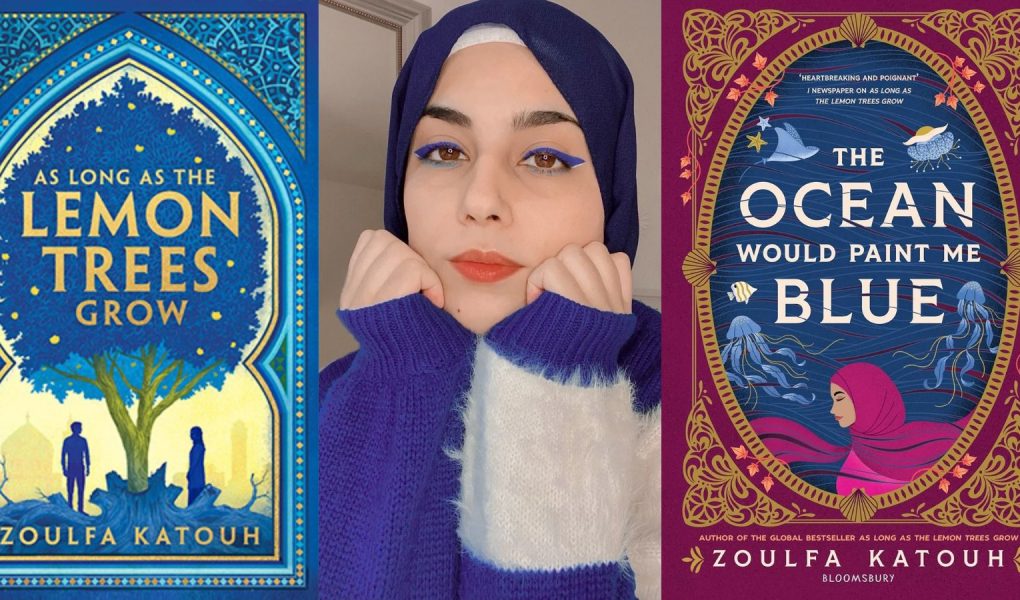
Three years ago, Zoulfa Katouh’s debut novel, As Long As the Lemon Trees Grow became a viral sensation. Dubbed “an epic, emotional, breathtaking story of love and loss set amid the Syrian revolution” that “will sweep you up and never let you go” its gorgeous cover and powerfully haunting prose captured the hearts and minds of readers internationally. The book was translated into 25 languages, it was shortlisted or won major awards including and propelled an unknown voice into the limelight becoming an international bestseller. This June, Zoulfa Katouh – the first Syrian author to be published in the UK and US – returned with her second novel, The Ocean Would Paint Me Blue, a heart-wrenching new story of friendship, loss and identity. The Asian Writer spoke to Zoulfa Katouh over Zoom.
Q. Do you write with an audience or mind in mind or does that comes later?
I do write with an audience in mind. Because I’m classified as a YA author and my target audience has always been kids in school, students, teenagers. That’s always been my audience. But I’ve had the happy accident I will say that it went like all over, like it transcended age, and that was also something that I really wanted, but I didn’t know if it would happen. I didn’t know if adults would also want to be reading these kinds of books and I was I was wrong. I was very happy that I was wrong. Adults very much enjoyed it. I’ve had a lot of readers who were giving Lemon Trees to their grandparents as well and that was that was great. That was awesome. I’ve never seen a grandparent read a YA book personally so it was really nice to see that that was happening.
Q. What does it mean for you to tell the stories that you do?
It means everything honestly. I never planned to be an author. I don’t want to say it fell into my lap, but it felt like it came from something deep within me to start writing. I can’t even explain it. I did not wake up one day and be like, “Oh, I want to be an author.” It just happened. And being able to write the stories that I wish I read when I was growing up, I never thought this was possible because I thought that we only existed within one frame that has always been shown throughout the media.
The fact is that we don’t have to like there’s another world out there. We don’t have to live the way we live. And it it took a lot of learning from me to be able to do that because there was no blueprint for me to kind of go off of or like get inspiration from. That was back when I was writing Lemon Trees. Thankfully, now we do have a bit more representation. Not as much as we want it to be, but we’re heading towards that direction. So, it feels like a blessing to be able to unabashedly write what I want to write without any constraints.
Q. Why do you write?
Writing for me is a form of therapy. It’s very cathartic. A lot of my writing sessions end up with me just staring out the window being like, “What did I just go through?” Like, you discover yourself a lot when you write. I started writing when I was 22 years old. So, I’m like, what was I doing before 22? How did I fill up my time? I don’t remember. So, writing has become an integral part of my everyday life, that it just become a part of my identity. I write because I’m alive.
Q. What role can literature play in bringing communities together at a time of division, war, and injustice?
It plays a very big role. I feel the basic thing that books like this do is create empathy. It builds empathy within people. It makes their worlds a bit bigger. It makes them understand other people. It makes them realise that there are lives being lived out there that they don’t know anything about and it makes the world smaller and bigger at the same time. And it just makes you feel less alone because for a lot of the issues that we go through, they feel very universal. I mean, Lemon Trees is one of these examples. I’ve had students and people from Ukraine talk to me about lemon trees and being like, “What you wrote is what we went through in Ukraine.” I would have never imagined that in a million years. I mean, and it just create it just shows how books transcend everything. Everything. There’s no restraints when it comes to books. And so, it brings people together in ways that you can’t even imagine.
Q. You’re touted as the first Syrian author to be published in both the US and the UK. Does that carry with it a weight of expectation?
Very much so. I don’t know if the weight of expectations is something that I only feel or if it actually does exist. I never want to be the face of Syrian people, for example. I just want to be the person who hopefully has opened the door for other voices and not just for Syrian voices, but for minorities that are not very much represented mainstream… and so this is something that I really hope gives people inspiration to write their own stories because we desperately need them.
I just hope that everyone who reads this book finds something for themselves. I try to make my books exist outside the boundaries of whatever the character is. For example, I know a lot of people might view this as a Muslim book because of Muslim characters, Muslim issues, but I don’t want it to be like that. I thought Lemon Trees was going to be like that. It was not. It it was for everyone. And that’s the same thing that I want from Ocean. I want every single reader, regardless of who they are, to get something from this book.
BOOK PREVIEW: The Ocean Would Paint Me Blue by Zoulfa Katouh
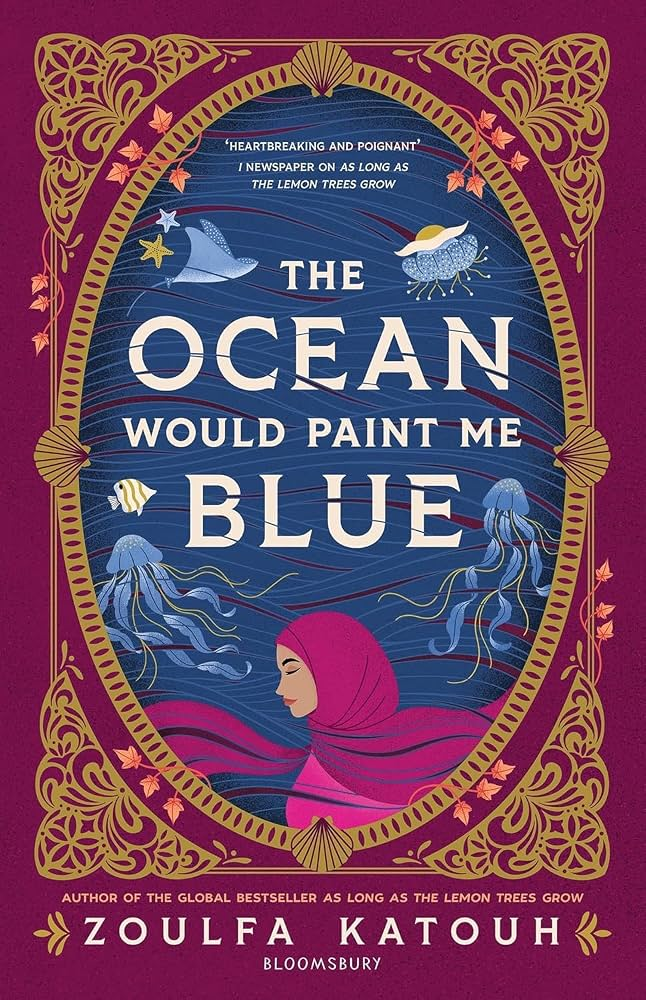
Joining an exclusive high school should be a fresh start for Jihad after her mother’s sudden death. But she’s the only Muslim student there; her hijab and even her name make her new classmates suspicious.
Only one person treats her with kindness but Jihad can’t help questioning his motives. It’s hard to trust anyone when she meets indifference or hostility all around her. As tension mounts, she finds refuge in an old sketchbook and in the stories her mama used to tell her. She is determined to focus on making it to art school and a brighter future, but as she starts illustrating her mother’s memories, her canvas becomes bigger than she could ever have imagined.
Can Jihad become as resilient as the true meaning of her name, and let the colour back into her life?
Zoulfa Katouh is the award-winning and bestselling author of the novel As Long As the Lemon Trees Grow. It’s been translated into over twenty-five languages and was a Governor General’s Award finalist and a Yoto Carnegie Medal nominee. Zoulfa holds a degree in pharmacy and a master’s in Drug Sciences. She resides in Switzerland where she lives as a Studio Ghibli protagonist who is surrounded by a never-ending stack of books that keeps growing. Her latest novel, The Ocean Would Paint Me Blue is out now.